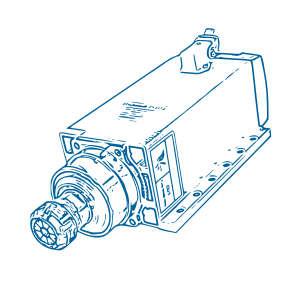

CNC Spindle Motor 0.3 kW, 60,000 RPM, 75V High Speed Water Cooled
The 0.3 kW Water-Cooled CNC Spindle Motor is a specialized micro-machining powerhouse designed for applications where surgical precision and extreme rotational velocity are required. Operating at an incredible 60,000 RPM, this motor is driven by an ultra-high frequency of 1000 Hz, providing the smooth rotational performance necessary for delicate tasks. Despite its compact footprint, the 75V architecture delivers a focused 0.04 Nm of torque, specifically balanced for high-speed micro-drills and fine engraving bits. The integrated water-cooling system provides critical thermal management, protecting the high-precision internal bearings from heat buildup during prolonged high-velocity cycles. Equipped with a micro-scale ER 8 collet system, this 2-pole motor is the industry standard for CNC bangle making, high-density PCB drilling, and detailed jewelry engraving where tool runout must be minimized to the micron level.
- Extreme High-Speed 60,000 RPM for micro-precision results
- Ultra-High Frequency 1000 Hz stable operation
- Compact Micro-Design ideal for delicate machining centers
- Precision Water Cooling for consistent thermal regulation
- Balanced 75V low-current architecture (1.5 A)
- ER 8 Collet system for high-accuracy micro-tooling
- Optimized for vibration-free micro-milling and drilling
Comparative Technical Spindle Motor Configurations Matrix
Use the structural data catalog matrix below to evaluate power outputs, maximum RPM, operating voltages, and cooling styles across standard TriQuench CNC spindle models.
| Spindle Capacity | Operating Speed | Operating Voltage | Cooling System |
|---|---|---|---|
| 12.0 kW | 18,000 RPM | 380 V | Water-Cooled |
| 0.8 kW | 24,000 RPM | 220 V | Air-Cooled (Long Shaft) |
| 3.7 kW | 40,000 RPM | 380 V | Water-Cooled ISO20 |
| 9.0 kW | 18,000 RPM | 380 V | Air-Cooled |
Technical Specifications
| Technical Parameter | Engineering Specification Value |
|---|---|
| MODEL NUMBER | W03240R75M1 |
| POWER RATING | 0.3 kW |
| MAX SPEED | 60,000 RPM |
| OPERATING VOLTAGE | 75 V AC |
| RATED CURRENT | 1.5 A |
| FREQUENCY | 1000 Hz |
| RATED TORQUE | 0.04 Nm |
| POLE COUNT | 2 Pole |
| COLLET INTERFACE | ER 8 |
| MECHANICAL | coolingType: Water Cooled | bodyType: Micro-Precision Series | precisionGrade: Surgical/Micro Grade Certified |
Industrial Applications
| Usage Scenario | Target Industry |
|---|---|
| Automated CNC Bangle and Jewelry Making | Jewelry and Luxury Goods Manufacturing |
| High-Density PCB Drilling and Prototyping | Electronics and Semiconductor Fabrication |
| Micro-Engraving and Watchmaking Components | Medical Technology and Instrumentation |
| Medical Instrument Micro-Machining | Precision Engineering and Micro-Milling |
| Precision Silicon and Glass Dicing | Educational R&D and High-Tech Labs |
| Advanced Micro-Scale R&D and Lab Prototyping | General Engineering |
Technical FAQ & Operational Guide
What kind of VFD is required for a 60,000 RPM motor?
Because this motor operates at an extreme frequency of 1000 Hz, it requires a specialized high-frequency Variable Frequency Drive (VFD) that supports output frequencies up to 1000 Hz or higher. Standard industrial VFDs are typically capped at 400-600 Hz and cannot drive this motor to its full speed.
Why does this motor use 75V instead of 220V?
At this ultra-compact scale, a 75V architecture allows for safer operation at extremely high rotational speeds while maintaining a very low current draw (1.5 A). This ensures the micro-windings stay within safe thermal limits while delivering precise torque.
Is water cooling necessary for such a small motor?
Yes. At 60,000 RPM, friction in the micro-bearings generates significant heat relative to the motor's size. Water cooling is essential to maintain thermal stability and prevent bearing expansion, which would otherwise compromise the surgical precision required for PCB and jewelry work.
Request Quote
Share your requirements, and we’ll provide a tailored quote.