
CNC Spindle Motor Manufacturer in India
TriQuench India manufactures precision CNC spindle motor and spindle drive systems from 0.3kW to 12kW, with speeds up to 60,000 RPM. Engineered in Ahmedabad with P4 ceramic bearings, ISO 1940 G0.4 dynamic balancing, and pan-India delivery.
What Is a CNC Spindle Motor?
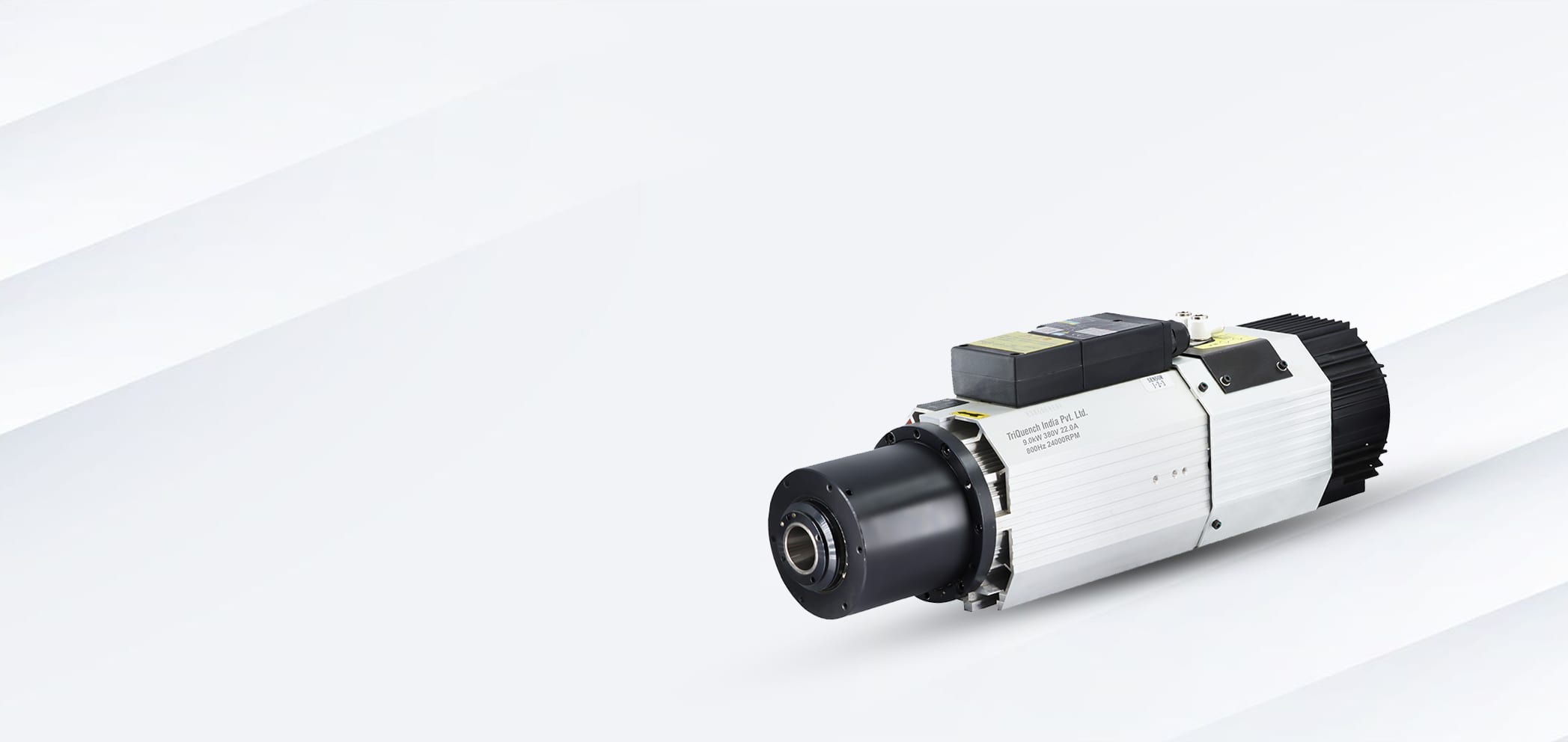
A CNC spindle motor is the rotating power unit that drives the cutting tool in a CNC machine, operating between 6,000 RPM and 60,000+ RPM depending on application. TriQuench India Pvt. Ltd., headquartered in Ahmedabad, Gujarat, manufactures CNC spindle motors from 0.3 kW to 12 kW in ATC, MTC, air-cooled, and water-cooled configurations with P4 ceramic bearings and sub-3 micron runout accuracy.
How a Spindle Motor Works
Power Transmission
The electric motor directly turns the precision spindle shaft, which holds the collet or tool holder at its nose. As the motor energizes, rotational torque transfers directly into the cutting tool without intermediate gears or pulleys.
Cooling and Thermal Control
Air-cooled spindles dissipate heat using an integrated shaft fan or electric blower passing ambient air over the housing. In contrast, water-cooled spindles circulate liquid coolant through internal jackets to maintain constant operating temperatures during continuous milling.
Speed Regulation
A Variable Frequency Drive (VFD) regulates spindle speed by adjusting the electrical output frequency supplied to the motor. Modulating this frequency allows operators to fine-tune RPM across diverse cutting materials and tool diameters.
CNC Spindle Motor Types We Manufacture
- ATC Spindle (Automatic Tool Change) — for automated multi-tool jobs
- MTC Spindle (Manual Tool Change) — for cost-sensitive standard production
- Belt Driven Spindle — for low-vibration heavy metal cutting
- Air Cooled Spindle — 0.8kW-6kW, woodworking and light engraving
- Water Cooled Spindle — 1.5kW-12kW, continuous heavy-duty milling
For dedicated machinery installations, TriQuench India also manufactures heavy-duty CNC lathe spindle assemblies for precision turning operations and rigid CNC milling spindle cartridges for vertical machining centers (VMC).
CNC Spindle Motor Specifications
| Spec | Range |
|---|---|
| Power | 0.3 kW – 12 kW |
| Speed | up to 60,000 RPM |
| Bearing grade | P4 ceramic |
| Cooling | Air or water |
| Runout tolerance | Sub-3 micron (0.003mm) |
| Balancing standard | ISO 1940 G0.4 |
Frequently Asked Questions
What is a CNC spindle motor used for?
A CNC spindle motor drives the rotating cutting tool in CNC routers, milling machines, and lathes, converting electrical power into the rotational force needed for cutting, engraving, or drilling material.
Who manufactures CNC spindle motors in India?
TriQuench India Pvt. Ltd. is a CNC spindle motor manufacturer headquartered in Ahmedabad, Gujarat, producing ATC, MTC, air-cooled, and water-cooled spindle motors for CNC routers and milling machines across India.
What factors determine the right CNC spindle motor for a machine?
Selection depends on required power (kW), tool-change type (ATC or MTC), cooling method (air or water), and target RPM range for the material being cut — heavier metal work needs higher power and water cooling, while woodworking typically suits air-cooled units.
Buy CNC Spindle Motors from TriQuench India
TriQuench India manufactures and supplies factory-certified CNC spindle motors engineered for high-speed routing, milling, and precision engraving machines across India. Contact our Ahmedabad technical engineering team today to request a custom specification quote or select the ideal spindle motor for your CNC setup.
Related CNC Spindle & Automation Categories
Air-Cooled Spindle Motors
0.8 kW to 7.5 kW forced air dissipation systems engineered for woodworking, MDF, and dusty processing cells without coolant piping.

Water-Cooled Spindle Motors
Ultra-quiet (<62 dB) liquid-jacketed motors built for continuous 24/7 aluminum, acrylic, and non-ferrous metal cutting.

High-Frequency VFD Drives
Precision variable frequency drives tuned for constant torque control, low harmonic noise, and multi-stage spindle protection.
CNC Router Kits & Mounts
Precision CNC machined mounting brackets, spindle clamps, and Z-axis structural mounting plates for zero-flex rigidity.
Fiber Laser & Automation Spindles
Heavy-duty automated ATC spindles designed for combined laser cutting and multi-axis automated CNC production centers.
Industrial Applications & Material Suitability
Selecting the appropriate CNC spindle motor depends on target workpiece density, cutting tool diameter, and expected material removal rates (MRR):
Woodworking & Furniture Manufacturing
High-torque 3.5kW to 6.0kW air-cooled spindles excel at continuous cutting of hardwoods, MDF, plywood, and veneered panels using ER25/ER32 tooling.
Aluminum & Non-Ferrous Metal Milling
Water-cooled 2.2kW to 5.5kW spindles operating at 18,000–24,000 RPM maintain cool bearing temperatures during aggressive metal chip evacuation.
Stone, Marble & Granite Engraving
Heavy-duty 5.5kW to 9.0kW sealed spindles with IP65 dust and liquid ingress protection withstand abrasive slurry environment in stone profiling.
Precision Electronics & PCB Prototyping
Ultra-high speed 0.8kW to 1.5kW spindles running up to 30,000 RPM with sub-3 micron runout prevent micro-drill bit breakage in circuit board fabrication.
Spindle Motor Maintenance & Failure Prevention
To ensure longevity and sub-3 micron runout precision from your CNC spindle motor, follow these operational best practices:
- Coolant Verification: Always confirm water chiller circulation before starting water-cooled spindle motors to prevent ceramic bearing thermal seizure.
- VFD Parameter Tuning: Set correct base frequency (typically 300Hz–400Hz) and acceleration/deceleration curves to prevent stator coil burnout.
- Daily Taper Cleaning: Wipe collets and taper tool holders daily with lint-free cloths to prevent runout degradation from chip contamination.
Quality Compliance & Regional Manufacturing in Ahmedabad
TriQuench is a premier manufacturer and technical supplier of industrial high-speed rotational equipment headquartered in Ahmedabad, Gujarat, India. All CNC spindle motor units undergo rigorous 100% factory verification testing prior to dispatch:
- ISO 1940 G0.4 Dynamic Balancing: Rotors are dynamically balanced on dual-plane electronic balancing equipment to guarantee rotational vibration below 0.5 mm/s.
- Clean-Room Bearing Assembly: Ceramic bearings are pre-loaded in Class 10,000 climate-controlled clean rooms to eliminate particulate contamination.
- Electrical Dielectric Inspection: Every spindle motor undergoes 1500V high-potentiometer stator insulation testing and surge resistance verification.
- Pan-India Logistics: Same-day dispatch availability across major industrial regions including Ahmedabad, Vadodara, Pune, Bengaluru, Chennai, Rajkot, Surat, and Delhi-NCR.